
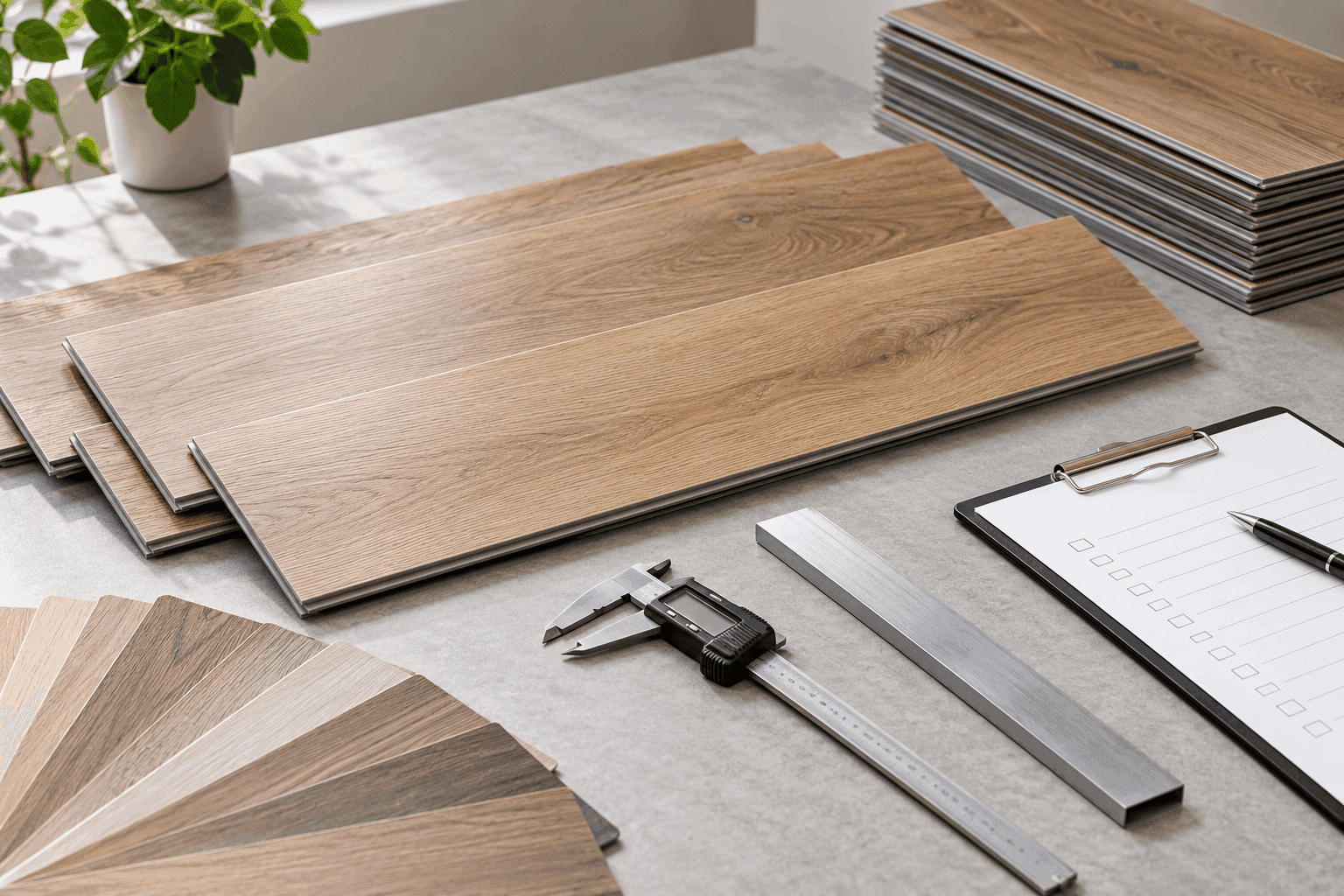
An SPC flooring inspection should compare the finished order against agreed criteria, not against a general impression that the product “looks good.” For importers, distributors and project buyers, the objective is to confirm product identity, record verifiable results and resolve any deviation before shipment is authorized.
This guide does not replace a technical specification, an agreed sampling plan or destination-market requirements. Define methods, tolerances, documents and responsibilities in writing before production. Where laboratory testing is required, use the method and laboratory accepted for the project.
1. Define the inspection basis before production
An inspection is useful only when the inspector knows what the product must be compared against. Assemble the purchase order, confirmed specification, approved sample, carton artwork and any report or destination-market requirement included in the agreement.
Also define who makes the final decision. The inspector should record facts and results, but acceptance of a commercial or technical deviation belongs to the authorized party. Avoid resolving material differences only through informal messages.
- Current order and specification
- Identified approved sample
- Visual and dimensional criteria
- Measurement methods
- Packing and labelling requirements
- Authorized owner for deviation decisions
2. Agree sampling and maintain traceability
There is no single sample size for every order. The plan should consider lot size, décors, production batches, the criticality of each characteristic and the buyer’s accepted risk. If a sampling standard is used, state the version, level and agreed criteria.
Select cartons from different positions and record batch, décor and location. A sample concentrated in one carton or pallet may miss differences between shifts, batches or packing stages.
- Lot size and composition
- Quantity by décor and batch
- Sampling plan and timing
- Cartons selected from different positions
- Identification of every sample
- Photographs and results recorded by reference
3. Check dimensions, tolerances and construction
Confirm length, width and total thickness with suitable tools and at the points required by the agreed method. Where applicable, also check squareness, straightness, bevel and any functional tolerance that can affect assembly.
Do not infer wear layer, acoustic backing or core formulation from total thickness or weight alone. These characteristics require documentation or specific methods. Record the equipment used and avoid comparing results obtained through different procedures.
- Length, width and total thickness
- Measurement method and points
- Squareness and straightness where specified
- Bevel geometry and consistency
- Correct construction and backing
- Results compared with agreed tolerances

4. Review surface, décor, colour and finish
Examine full planks under representative lighting. Compare colour, décor, texture, gloss and bevel with the approved sample, taking pieces from several cartons to observe batch consistency and intended design variation.
Record scratches, stains, contamination, incomplete printing, edge damage or other findings under the agreed categories. A single photograph can distort colour; include references, lighting information and wider views when documenting a visual difference.
- Décor code and batch
- Colour under agreed lighting
- Texture and gloss level
- Pattern repeat and visual variation
- Bevel and edge finish
- Scratches, stains, printing and contamination
5. Inspect click profiles, backing and assembly
Visually inspect the click profile for burrs, breakage, debris or irregular machining. Assemble several planks using the sequence specified for the profile and observe alignment, joint closure and visible lipping without forcing the pieces.
Where IXPE or EVA is included, confirm the specified material and thickness through the agreed method, together with coverage, bonding and edge condition. A licence or click-system name does not replace inspection of the finished product.
- Correct and clean profile
- No visible burrs or breakage
- Correct assembly sequence
- Aligned and closed joints
- Correct, even and bonded backing
- Samples retained when a deviation appears

6. Verify packing, labels and weight
Check pieces and square metres per carton, carton condition, internal protection, label, shipping marks and pallet configuration. References should match the quotation, order, packing list and invoice.
Weigh finished cartons under the agreed plan and record the results. The loading estimate should be updated with confirmed gross weight, including pallets and additional protection, before the container booking is finalized.
- Pieces and square metres per carton
- Carton, bag, protection and straps
- Label, batch and décor code
- Checked net and gross weight
- Cartons per pallet and pallet condition
- Consistent data across all documents
7. Document findings and control release
The report should allow someone who was not present to understand what was checked, how it was measured and what was found. Include order identity, date, location, production status, samples, tools, results, photographs and open deviations.
Do not automatically treat an inspection report as shipment authorization. Deviations should be classified and resolved in writing. If rework or replacement takes place, define the scope of reinspection before releasing the order.
- Order and lot identification
- Product status at inspection
- Samples, tools and methods
- Results and photographic evidence
- Deviations and affected quantity
- Corrective action and reinspection
- Written authorization before shipment
SPC flooring inspection FAQ
When should an SPC flooring order be inspected?
Control points depend on the order. The sample and specification should be approved before production, while the pre-shipment inspection should take place when enough finished and packed goods are available to assess the lot under the agreed plan.
Is an approved sample enough to control quality?
Not by itself. A sample is a visual and physical reference, but it should be supported by a written specification, tolerances, measurement methods, packing requirements and applicable documents. It must also be correctly identified and retained.
Which SPC flooring dimensions should be checked?
Depending on the specification, checks may include length, width, total thickness, squareness, straightness, bevel and other defined features. Wear layer and backing require appropriate verification methods and should not be inferred from total thickness alone.
How should colour or décor variation be evaluated?
Compare full planks under agreed lighting with the approved sample and with pieces taken from different cartons. Separate intended design variation from staining, batch differences or other unaccepted defects.
What should happen if an inspection finds a deviation?
Record the finding, affected quantity, references and evidence. Buyer and supplier should agree in writing on classification, rework, replacement, reinspection or another disposition before shipment is authorized.